
All experience and objective data over the past eight years has shown that every successful effort to reduce robocalling has been the result of an enforcement action or fear of an enforcement action.
- In 2016, IRS impersonation calls declined 85% after a single investigation by local police in India. Further information can be viewed HERE.
- In 2017, robocalls declined almost 50% after a single lawsuit against one company that used neighbor spoofing to deliver calls about vacation package offers. Further information can be viewed HERE.
- In 2018, Canadian Revenue Agency impersonation calls declined 77% after a series of raids by Indian police. Further information can be viewed HERE.
- In 2019, health and health insurance related robocalls declined 60% after a single lawsuit against a Canadian VoIP provider. Further information can be viewed HERE.
- Between 2021 and 2022, car warranty related robocalls declined 95% after enforcement actions by the FCC and FTC. Further information can be viewed HERE.
The reason why such a limited number of enforcement actions have had such a dramatic impact on reducing robocalls is that the large majority of illegal robocalls are generated by a relatively small number of criminal groups.
Since July 2021, the FCC has required all voice service providers to register with the Robocall Mitigation Database (RMD). Traceback is conducted through e-mail. When a phone company attempts to trace an illegal call, each phone company in the chain of providers between a call’s point of origination and termination is contacted. This means that, many times, the criminal sending an illegal call is aware the call is being traced.
Even though robocall mitigation plans submitted through the RMD are frequently pro forma, and there is no verification they are being implemented, RMD registration, in and of itself, means all voice service providers allowed to connect to US phone companies are publicly identified. The combination of tracebacks and the RMD registration requirement has created an environment where criminals’ perceived risk of discovery reduced robocalls 62% between July 2021 and December 2023.
However, reported dollar loss fraud initiated by telephone increased 91% between July 2021 and September 2025. This is because, deterred from making large volumes of outbound calls, sophisticated Transnational Criminal Organizations (TCOs) that specialize in scams shifted to distributing call back numbers through computer pop-up ads, spam e-mail, and text messages.
This has primarily manifested itself as tech support fraud (see FVRO: How to Stop Tech Support Fraud) and other schemes such as cryptocurrency exchange takeovers that rely on distributing call back numbers.
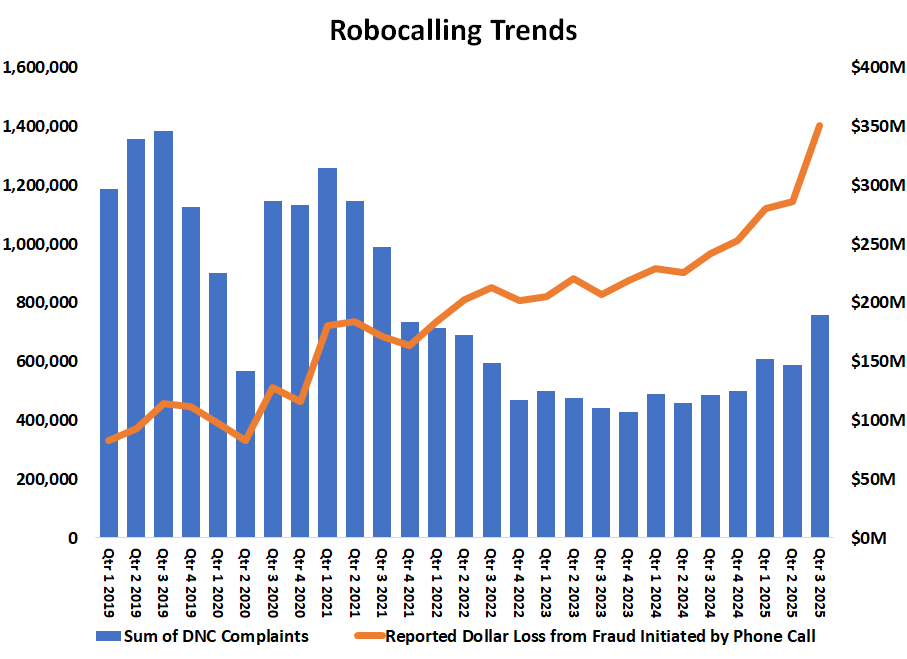
Source: FTC Tableau > Do Not Call Complaints > Robocalls
FTC Tableau > Fraud Reports > Payment and Contact Methods > Contact Method
It should be noted that since December 2023, robocalls have steadily increased again. Unwanted complaints in Q3 2025 were 57% higher than Q4 2023 (though still 40% lower than Q2 2021). Examination of call complaints by category reveals that 70% of this increase came from one category of call: reducing debt. Historically, this homogeneity in trending indicates calls are coming from a single robocaller or, at least, a small group. This, in turn, indicates this increase is the result of the FCC and FTC not following up on traceback reports.