
On April 6 the FBI released its 2025 Internet Crime Report, showing a 26% increase in reported financial loss over 2024 due to online crime. This report illustrates several opportunities to reduce scams and consumer fraud in 2026. It also highlights the need for more comprehensive public release of underlying data so additional opportunities for improvement can be identified.
2025 saw several signs of progress is the war against America’s scam epidemic.
- Political instability combined with diplomatic pressure from China resulted in disruption of large-scale scam compound operations in Myanmar.
- Criminal indictments, sanctions, and diplomatic pressure from the U.S. resulted in disruption of large-scale scam compound operations in Cambodia.
- U.S. law enforcement relations with overseas counterparts in India and West Africa continued to improve.
- Several important bills have been introduced in Congress focusing on improving law enforcement responses to America’s scam epidemic.
As with 2024, the 2025 Internet Crime Report showed 70% of reported loss came from five homogenous scam types specifically associated with three regions of the world.
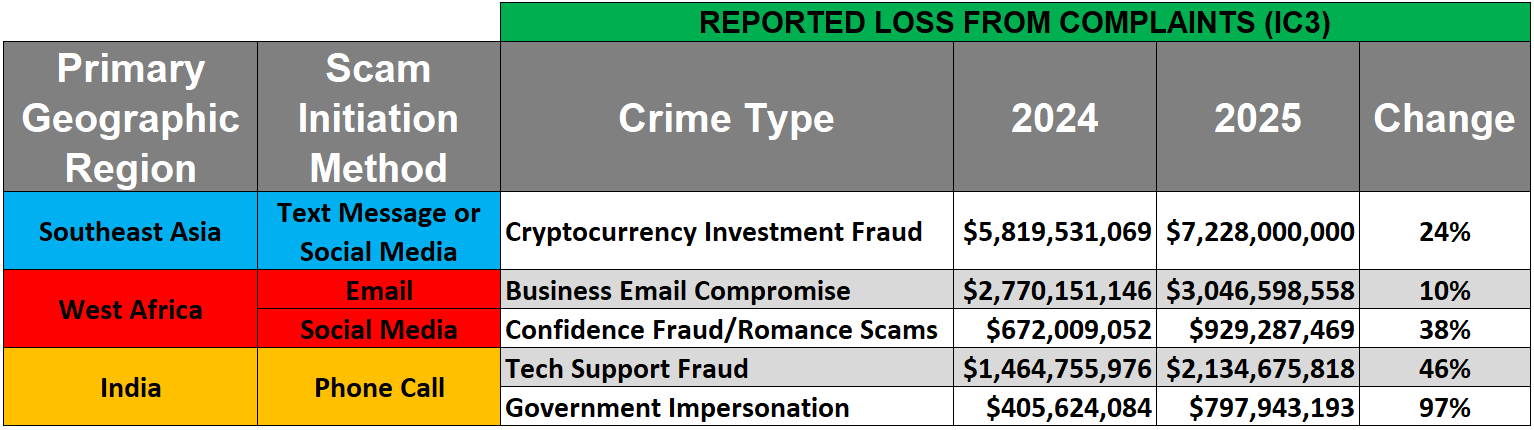
This indicates the large majority of scam loss comes from a relatively limited number of criminal groups.
Cryptocurrency Investment Fraud
Cryptocurrency Investment Fraud is primarily associated with large-scale scam compounds in Southeast Asia—though similar operations have been discovered in other parts of the world.
Overall, FBI reported a 26% increase in loss due to internet crime, from $16.6 billion in 2024 to $20.9 billion in 2025. Cryptocurrency Investment Fraud increased 24%, from $5.8 billion in 2024 to $7.2 billion in 2025.
Of note, Investment Fraud not categorized as Cryptocurrency Investment Fraud increased at a significantly higher rate than Cryptocurrency Investment Fraud.
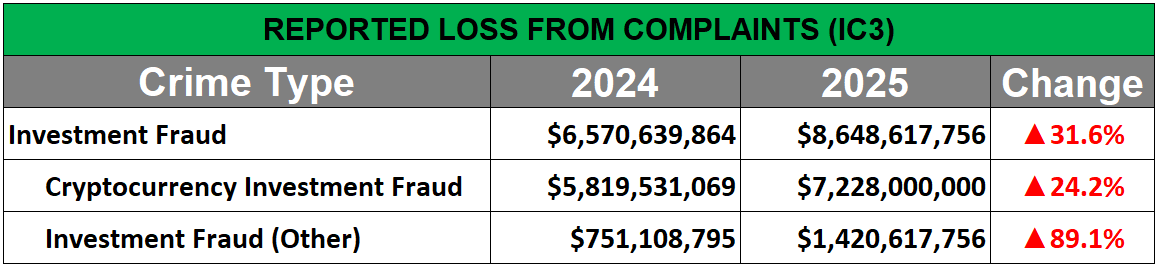
- Does this indicate the emergence of new fraud types or new large-scale crime groups outside Southeast Asia?
- Or does this mean some investment scams from Southeast Asia were not categorized as Cryptocurrency Investment Fraud because funds were transferred by wire to recipients other than cryptocurrency exchanges?
The IC3 report provides limited details. Other questions are also left unanswered.
- Was the increase in Cryptocurrency Investment Fraud significantly higher than 24% in the first half of 2025 and then significantly lower in the second half?
- Or were crackdowns in Myanmar and Cambodia ineffective and/or largely performative?
- Or were scam operations successfully able to relocate and disperse within Myanmar and Cambodia?
- Or did the relocation of large-scale scam operations outside Southeast Asia significantly accelerate in 2025?
Additional public information is needed to answer these questions and develop opportunities for improvement. At a minimum, FBI needs to publish loss statistics by category and month.
Tech Support Fraud and Government Impersonation
Tech Support Fraud and Government Impersonation primarily originate from criminal call centers in India.

While U.S. law enforcement executives report good relations with their Indian counterparts, the 47% increase in tech support fraud clearly indicates the previous practice of bundling cases into annual or periodic “sweep” operations is not effectively driving deterrence. The cycle time between development of evidence and transmission of Foreign Dissemination Reports to Indian police needs to be reduced. U.S. law enforcement needs to focus less on building large, comprehensive cases and more on getting information about locations of scammers to Indian police as quickly as possible.
To facilitate this, internet browser providers like Microsoft, Google, Apple, and Mozilla need to identify and send tech support fraud pop-up ad images to IC3 in near real time.
In addition, the 97% increase in government impersonation loss almost certainly indicates the emergence of new criminal groups outside India—most likely in the Dominican Republic.
Business E-Mail Compromise and Romance Scams
Business E-Mail Compromise and Romance Scams primarily originate from criminal groups in Nigeria and Ghana.

Of particular note is the fact that loss from these scams do not always increase every year.
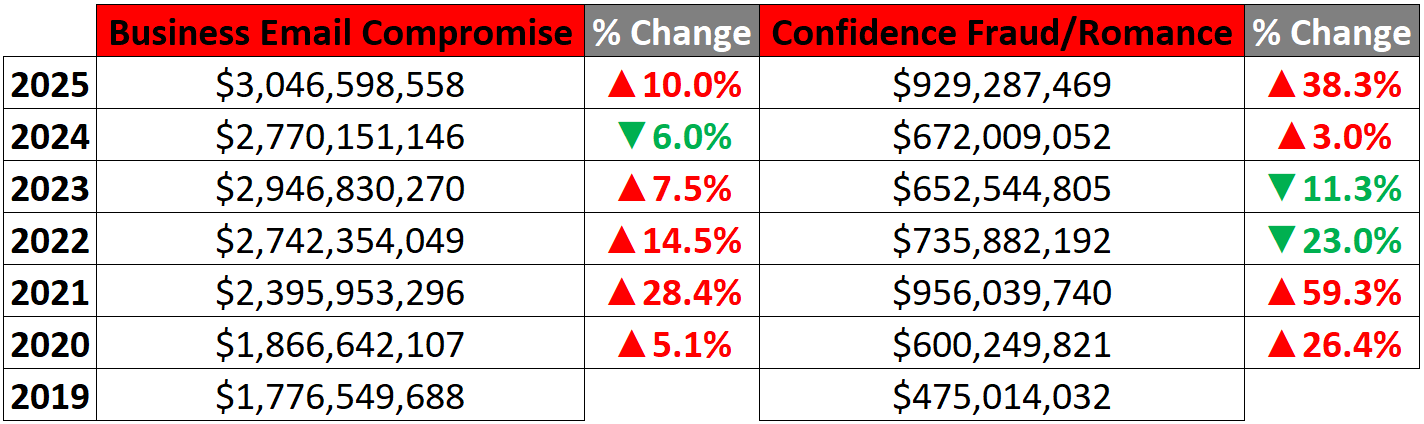
- Does this indicate the emergence of new criminal groups outside West Africa?
- Or does this indicate West African crime groups transition between scams reported in IC3 data and other frauds such as identity theft, access device fraud, bank fraud, or public benefits fraud that may not be reflected in IC3 complaint data?
Additional public information is needed.
Other Internet Crimes
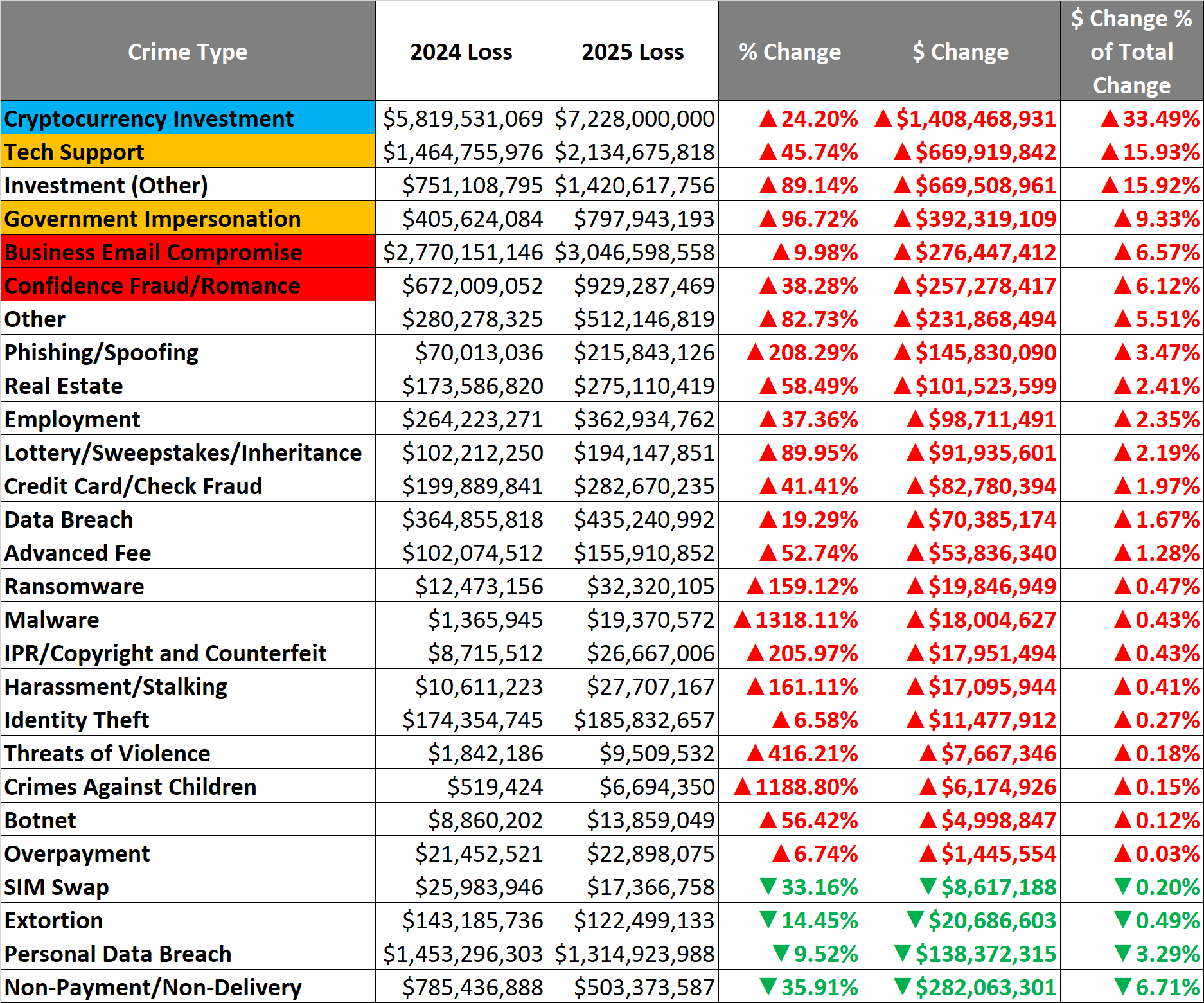
Year-over-year changes in fraud loss for all reported categories internet crime are shown below.
RAT
The FBI’s Recovery Asset Team significantly increased victim recoveries during 2025.

This indicates additional recovery is possible through streamlining processes; for example: centralizing tasks within IC3 instead of referring recovery attempts to an FBI field office.
Operation Level Up
FBI saw a reduction in the number of fraud victims proactively notified through Operation Level Up.

This may have been due to changes in how large-scale scam compounds use certain internet service providers. If so, FBI should explore additional opportunities for notifying scam victims through certain internet service providers.
AI Enabled Crime
The 2025 Internet Crime report showed $893,346,472 in loss (5% of reported loss) from AI enabled cybercrime.
Victim Rights Waivers
Throughout 2025, FBI required crime victims to waive certain rights under the Federal Crime Victims’ Rights Act (CVRA) in order to be able to file reports online through IC3.gov. Victims who decline these waivers are unable to file reports online through IC3.gov.
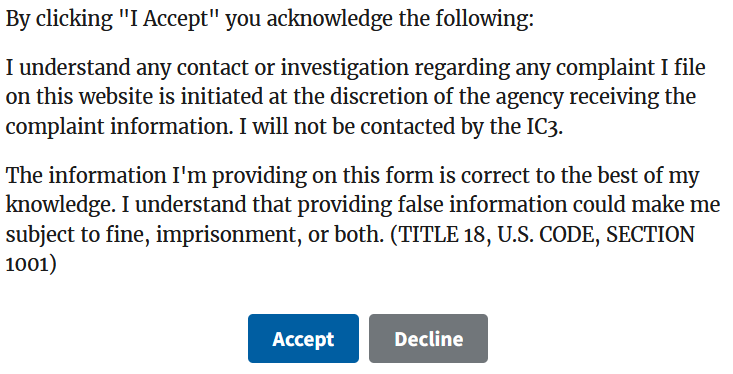
This is almost certainly illegal.
CVRA provides victims of Federal crimes with certain rights, including: “(5) The reasonable right to confer with the attorney for the Government in the case.” The purpose of filing a police report is so law enforcement can protect the victim, try to make them hole, and to bring criminals to justice. That is why taxpayers fund law enforcement agencies.
For most internet crimes, there are multiple State, local, and Federal law enforcement agencies with which a crime victim can file a report. If the FBI is unwilling to disclose whether any particular report is being investigated at all, a crime victim has no idea whether or not they should file reports with other agencies.
A downloadable copy of this report with references is available HERE.

Be the first to comment